Introduction
For the last ten years, productivity has been almost equated to a lifestyle goal. On social media, you can see people’s lives filled with early mornings, busy schedules, and constant ‘grind’ routines that mainly glorify being busy. Back then, this kind of thinking used to represent ambition and success, but nowadays, quite a number of people are questioning its impact on their lives in the long run. The unceasing desire to perform and the reluctance to take breaks have inadvertently led to a major issue in today’s society that everyone can hardly overlook.
With the increasing demands on work and accomplishments, a great number of people are beginning to understand a meaningful life in a different way. This change is not only their own, but it also represents a larger cultural movement that questions the notion of success.
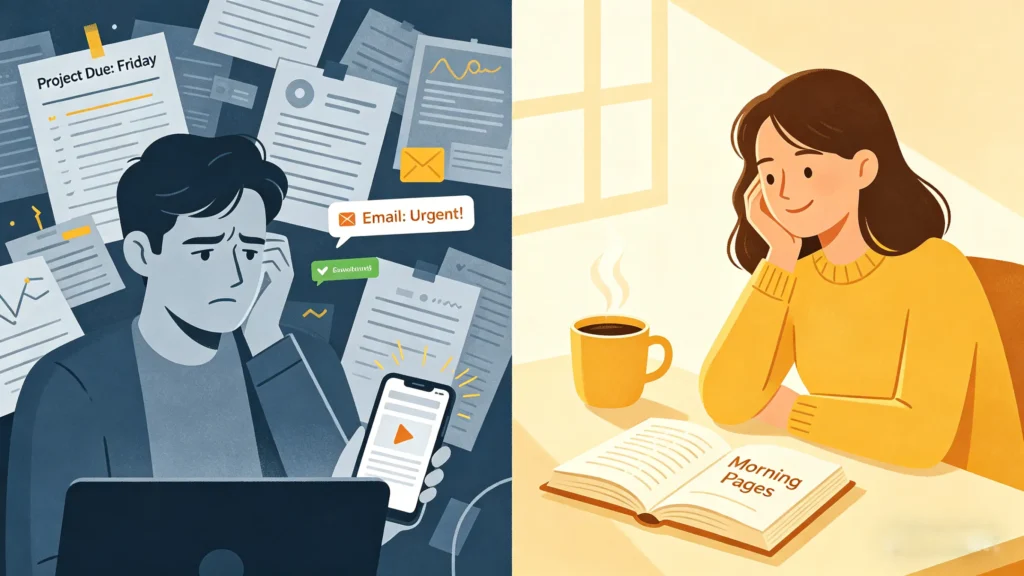
Understanding Hustle Culture Burnout and Why It Is Becoming a Global Problem
At the heart of this change is the increasing recognition of hustle culture burnout, a syndrome that has become recognizable especially in ye fast work environments. Hustle culture advocates the notion that successes come only through ceaseless exertion, long working hours, and giving up on one’s personal time. Although this way of thinking might push a person’s productivity level up in a short time, its effects are emotional and physical exhaustion over a longer period.
Common symptoms you can see or even experience in hustle culture burnout are such as feeling constantly tired, not having enough energy to do the things that used to motivate one, being angry/upset easily and having a feeling of being mentally “stuck” even if you keep on putting effort. A very common thing even many people nowadays face is the problem of not knowing where to draw a line between working and personal life, the presence of remote and digital work makes it still more difficult for one to not be “always available” as it has become quite a norm.
One of the major causes of hustle culture burnout is social comparison. These platforms that exhibit highlight snippets of success often lead to the creation of unrealistic expectations, which make people feel like they are always behind. Besides that, competition at workplace and the pressure to perform keep convincing people that resting is a waste of time, which leads to an even higher level of burnout.
With the rise in awareness, people are increasingly accepting that such a way of life cannot be maintained indefinitely. Discussions w mental health have unveiled the severity of the consequences of prolonged exposure to hustle culture, both from an emotional and a physical point of view.
The Work Life Balance Trend and How People are Redefining Success
As the number of people suffering exhausted due to hustle culture keeps increasing, a big work life balance trend spreading in many industries and among different cultures. This change basically shows that people have altered their mentality towards work, being productive and taking care of themselves.
The work life balance trend is about properly dividing professional and personal time so creating healthier boundaries. So rather than looking at working hours or output as the only way of defining success, people today are focusing on the sustainability of the work, mental health and quality of life.
Flexible working arrangements including remote work and hybrid models have been a big boost for this trend. A growing number of companies are even experimenting with shorter workweeks or more flexible schedules as they have realized that employees who are well rested tend to be more productive and creative. In fact, this movement towards work life balance trend is being recognized as not only a matter of personal choice but also of an institutional strategy.

As individuals, many are moving towards a slower and more deliberate way of life. This means going offline more frequently, making rest a priority and doing things that help one’s mental health. Rather than “doing more,” the focus is now on “doing what matters.”
The work life balance trend is a reflection of bigger cultural changes including the way in which success is defined. In fact, success is no longer seen as being associated with busyness all the time but rather with having time, energy and personal fulfillment at one’s disposal.
Conclusion
Increasing recognition of the fatigue caused by hustle culture is a pretty obvious indicator of the shift in values that are taking place in modern societies. What used to be a sign of ambition is now being evaluated for the harm it causes in the long run. Meanwhile, the emphasis on work life balance is altering the way people and companies view productivity and well-being.
Instead of focusing only on maximum output, lots of people want to have a balance, include rest, and live in a sustainable way which are all at the center of a successful life. Such a transformation indicates that the workplace of the future won’t be about doing more but about living well.

FAQ
What is hustle culture burnout?
Hustle culture burnout refers to mental and physical exhaustion caused by constant overworking and pressure to always be productive.
Why is the work life balance trend growing?
The work life balance trend is growing because people are prioritizing mental health, flexibility, and long-term well-being over constant work pressure.
Can hustle culture burnout be reversed?
Yes. It can be improved by setting boundaries, reducing workload, and adopting healthier daily routines that support rest and recovery.

